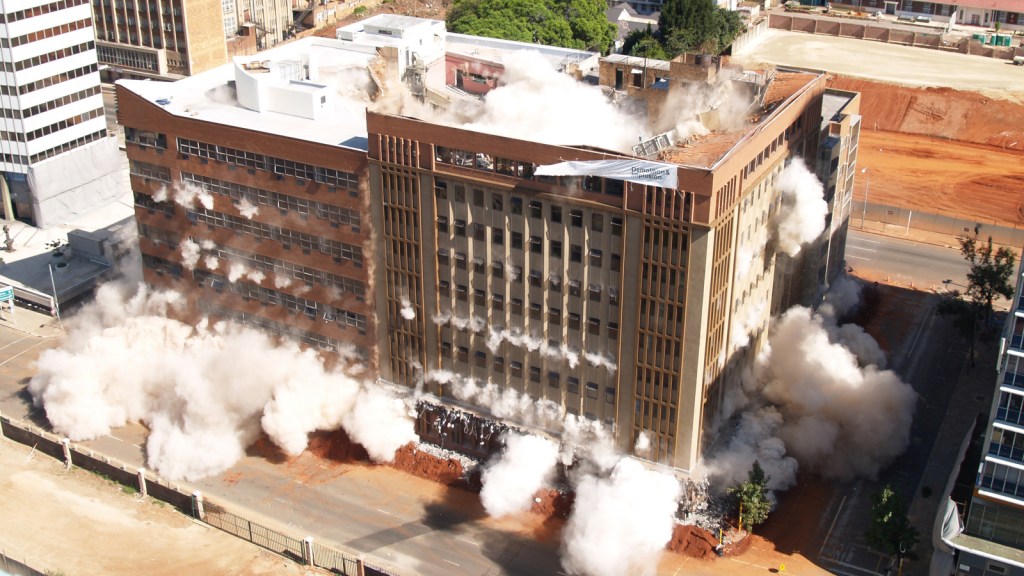
When the news about the fight between Trump and Musk surfaced, it made me think of implosion and how that seems to be a common thread in the chaos in the world right now.
According to the Oxford Dictionary, an implosion is “an instance of something collapsing violently inwards.” Stars implode, an organization or system can implode, and the dictionary also mentions “a global financial implosion” as an example. It’s the inward collapse of a system, institution, or structure from its own internal contradictions.
A personal implosion: burnout
Implosion is the opposite of explosion, and in a more philosophical sense, you can describe it as something that collapses under the weight of its own dynamics. You could see a burnout as an implosion, too, a personal one. It’s often not so much the external environment – that can be very toxic though – but the ways we respond to it or let it cross our boundaries that causes the collapse. Our unsustainable internal dynamic.
With the knowledge I gained from yoga teacher training, meditation practices, and studying holistic lifestyle coaching, I came to understand how burnout is also caused by a disconnection between mind and body. Internal pressure overrides the body’s signal, suppresses emotional responses, and causes depletion. The mind runs the show, focusing on deadlines, status, and impact, while the body whispers exhaustion. The more you try to fix it, the more you’re feeling unwell, and eventually, there is emotional numbness, mental disinterest, and physical fatigue. It’s a total collapse of something that’s been slow-cooking for a while.
Global implosions
It makes me think of many situations playing out on a global scale at the moment, the climate collapse that’s developing slowly but certainly, the changes in geopolitics that might feel shocking but at the same time have been developing for some time, and the movements in the media industry that seem disruptive but are probably more of an outcome of years of status quo attitudes.
The road to the implosion of a systemic model can be seen as parallel to a mechanical implosion:
- A pressure that builds up from inside; a rise in polarization, internal contradictions, inefficiencies, injustices (not working inclusively), and unsustainable practices.
- A weak core that can’t sustain the pressure; cracks are developing in trust (hi media!), institutions are failing (the UN, the ICC in the context of Gaza), and there is a cognitive dissonance between ideals and reality (Western morals, anyone?).
- Habit loops accelerate the decay when the failures cause apathy, and apathy leads to more internal failures. When you’re in a habit loop, chances are you keep focusing on the same thing, whereas in a crisis, you need a broader view to get out of it.
- A fear of adaptation takes over, and the system becomes fragile.
- And just like a mechanical implosion, it doesn’t have to be a big event to set off the collapse. It can be a fight (Elon Musk vs Donald Trump), a protest (Gaza), or a scandal (Sam Altman and OpenAI).
Fill the gap with honesty
An implosion also implies that there is hollowness inside, otherwise, there is no space to collapse, right? So on the one hand, it’s a failure of a system, but on the other hand, you could also say that, simultaneously, there hasn’t been enough energy put into building a healthy internal landscape.
Think of the mental health crisis in the media industry, and the lack of attention to that aspect of our work that has caused this unhealthy work ethic and atmosphere. The good thing is, you don’t need to find the solution outside if the internal processes collapse. The mental health crisis can be repaired by us if we rethink our processes and ways of doing things.
Even in the context of Israel’s genocide in Gaza, there are signs that Israel as a country is losing so much of its credibility internationally, and the problems internally are increasing; the country will implode at some point because of its actions. The same is happening in the US right now. It seemed a powerful marriage between Donald Trump and Elon Musk, but a seemingly small fight exposes long-term, slow-cooking polarization on different topics. If people from the outside are afraid that negative forces become too powerful, it now shows that something that is built on hollowness won’t survive in the long term.
If you’re afraid of implosion on a personal or professional level, make sure to:
- Develop self-awareness and adjust your path to the intended destination or outcome
- Redistribute your power and resources. On a personal level, it might look like setting clear boundaries; on a professional level, you might want to hire people with a different skill set, or invest in training for the current employees
- Adjust your strategy to make sure there is logic in your system, instead of just changing people in your team. On a personal level, this can look like implementing self-discipline or more of a healthy daily rhythm for your work, but also reconnecting body and mind.
- Be honest with yourself and reckon with the internal contradictions, both personally and professionally. I wrote about grief before, and it was liberating to be so open about it.
I love coaching and mentoring people 1-on-1 on change management, embracing uncertainty, and staying calm in the chaos. Have a look at what I offer and book a free call to explore a possible collaboration.
This is the fourth blog of what should become a thousand. Curious to read the first three? Check the series Thousand blogs.
 Inclusive Journalism
You must be logged in to post a comment.