“When people have low efficacy, anxiety-inducing messages lead to defensiveness, fear, helplessness, and a desire to tune out”.
David Bornstein, co-founder of the Solutions Journalism Network.
Solutions Journalism is used here as a reporting method and editorial lens. Inclusive Journalism works with journalists, editors, and newsrooms who want to report on responses to social problems without drifting into optimism, advocacy, PR, or simplification.
In practice, Solutions Journalism is applied alongside narrative analysis, decolonial perspectives, and questions of sustainability and well-being in journalism. The focus is not on producing “positive stories,” but on strengthening editorial judgment, rigor, and relevance for audiences and practitioners alike.
Solutions Journalism is defined by a set of core principles that guide reporting and editorial decision-making:
- Response – focuses on a response to a social problem — and on how that response has worked, or why it hasn’t.
- Insights – shows what can be learned from a response and why it matters to a newsroom’s audience.
- Evidence – provides data or qualitative results that indicate effectiveness (or lack thereof).
- Limitations – places responses in context; doesn’t shy away from revealing shortcomings.
Options
Solutions Journalism – introduction
An introduction to Solutions Journalism as a reporting method and editorial approach. The session outlines the core principles of Solutions Journalism and clarifies how it differs from constructive or positive storytelling.
Using examples from journalists and newsrooms working in different contexts, the focus is on how the method strengthens rigor, relevance, and explanatory depth.
Duration: 1 hour (online) | 1,5 hours (in-person)
Solutions journalism – workshop
A practice-based workshop for journalists who are already familiar with Solutions Journalism and want to apply it more deliberately.
Through focused exercises and discussion, participants work on story ideas, reporting choices, and evidence, with room to concentrate on a specific topic or editorial challenge.
Duration: 1 day (online) | 1-2 days (in-person)
Complicating the narratives
An introduction to the journalistic practice of Complicating (or Deepening) the Narrative that draws from the experience of experts in conflict mediation. The strategies and techniques help journalists tell richer and fuller stories about divisive issues – stories that illuminate and provide clarity and understanding, not further division.
Duration: 1,5 hours (online) | 2 hours in-person
Mentoring
Mentoring is available for journalists or newsrooms already working with Solutions Journalism who want sustained, critical feedback.
The focus is on editorial judgment, story structure, evidence, and limitations across the reporting process, from initial idea to publication and distribution.
Duration: per 30 – 60 minutes, frequency up to the mentee.
In practice, Solutions Journalism and Complicating the Narrative are often used together. While Solutions Journalism focuses on reporting rigorously on responses to social problems, Complicating the Narrative addresses how stories are framed, whose perspectives are centered, and which assumptions remain unexamined. Combined, they support journalism that is both analytically strong and attentive to power and complexity.
Introduction to Solutions Journalism
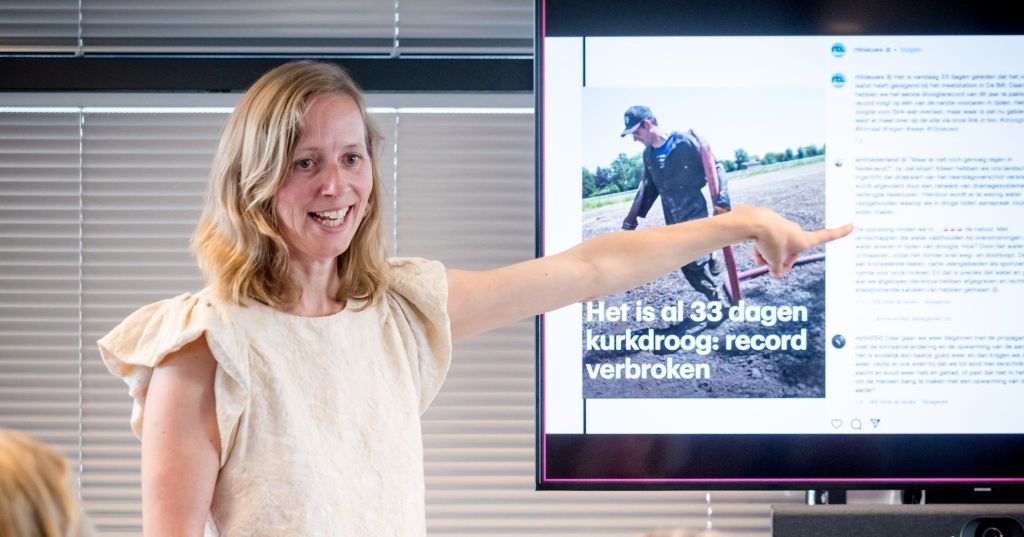
In 50-60 slides with time for questions and discussions, the introduction to Solutions Journalism gave the newsroom of RTL in Hilversum, The Netherlands, a clear idea of what the method entails. In this case, the presentation was tailored towards climate change reporting in collaboration with Imagine2050. Is Solutions Journalism activism (no), and can it be done in a 3 minutes video (yes), were some of the questions asked.
Solutions journalism, well-being, and decoloniality
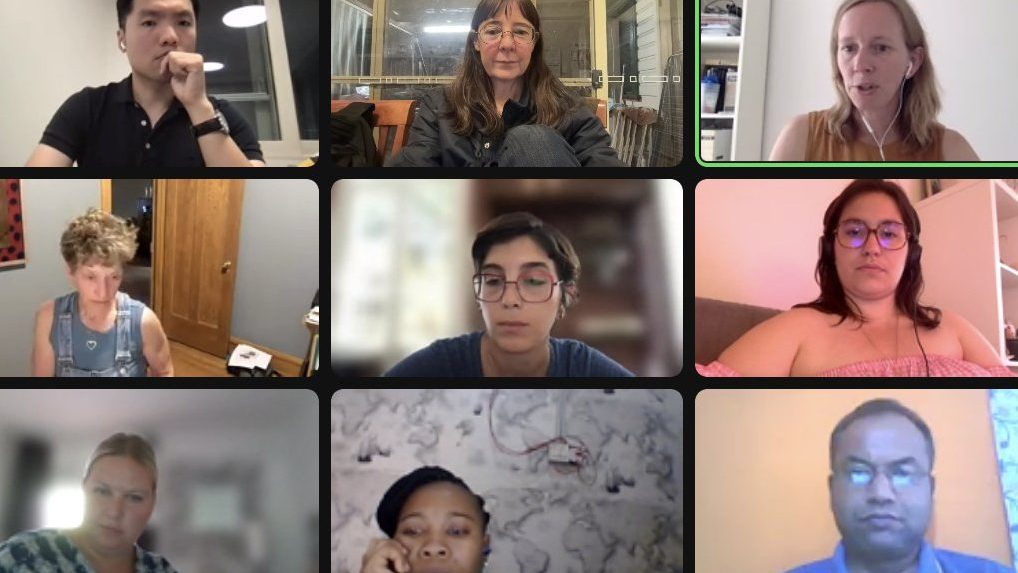
Working on a Solutions Journalism story often makes the journalist feel better about her or himself as well. Nobody wants to only focus on what is going wrong in this world. And by focusing on responses to problems, characters in the story go from being victims to being powerful actors. There are common threads between Solutions Journalism, well-being and inclusion/decoloniality. In the Solutions Journalism retreat, all these aspects come together.
Case Studies
Testimonials
“Sanne has been our mentor through the Solutions Journalism Accelerator by the European Journalism Centre and the Solutions Journalism Network. She’s been incredibly supportive and encouraging while providing useful challenges to help us develop and progress in our work. She also came up with some really great ideas that we implemented. Sanne’s advice on solutions journalism has been invaluable, and she’s really helped me think through how to write and commission articles giving really useful constructive feedback at every stage of the process. Sanne has gone out of her way to help connect us with people and ideas that have enriched our work.”
Amy Hall – co-editor at New Internationalist.
“The mentoring gave us a lot of valuable experience as we were guided on how to organise the data that we gathered from the interviews by making comparisons with other countries, exploring other angles of the features and analysing the statistics that we received from authorities.” – Rohani Ibrahim
“This mentoring process provided me with a good skill of applying solution journalism under the guidance of Sanne. Before this, I only subscribed to the newsletters from Solution Journalism Network and never thought that would be applying that to my stories. Thank you, Sanne for helping us produce a series of good stories, and applying Solution Journalism in our writings.” – Soon Li Wei
Rohani and Li Wei are Malaysian journalists who received mentoring as part of a Thomson Reuters Foundation training about modern slavery and human trafficking in 2023.



 Inclusive Journalism
You must be logged in to post a comment.