Panel at the Ubud Writers and Readers Festival, 2025
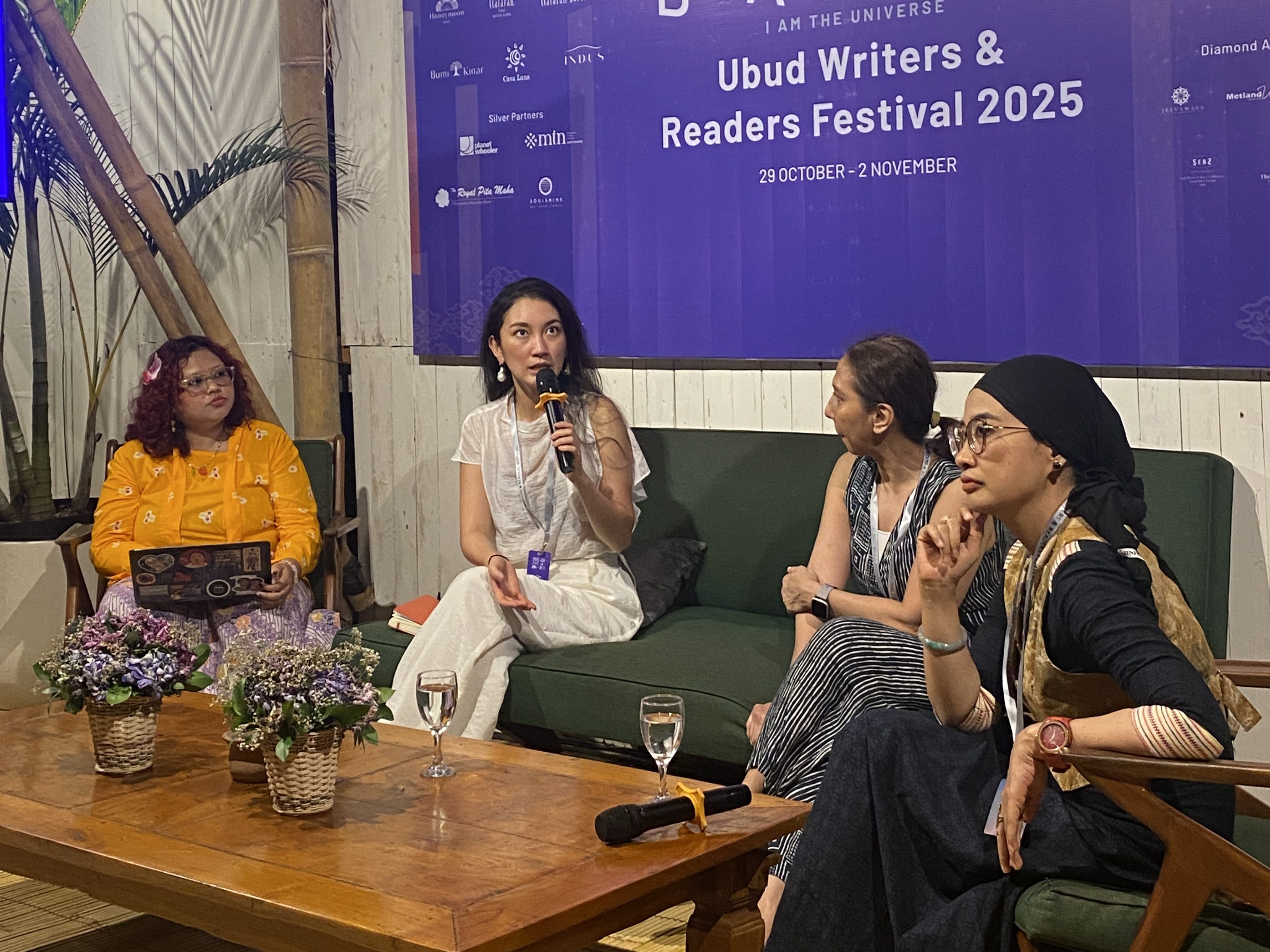
How is feminism evolving and being challenged by the so-called “patriarchal extinction burst” in today’s social media era? The phrase is used to describe the global backlash against gender equality that manifests in new ways online, from the “tradwife” trend to the Red Pill phenomenon.
It was the core question in the panel discussion “Beyond Backlash: Imagining an Equal Future” at the Ubud Writers and Readers Festival. Organized by women-focused, Indonesian publication Magdalene, the session brought together three prominent Asian feminist voices: Devi Asmarani, Okky Madasari, and Shiori Itō, moderated by Jasmine Floretta Vasthia Devi.
Women as Tokenism
An example that illustrates how hard it can still be for women to express themselves in today’s world came from an audience question. A Balinese woman shared how this era feels more “dangerous” for women, not only because of visible backlash but also because women are increasingly used as tokens by powerful men.
She mentioned the exhibition “Sunting,” held at the National Museum in Jakarta from April to July 2025. While presented as a tribute to Indonesian women, the exhibition faced criticism for its tokenistic framing.
As The Jakarta Post pointed out, the title itself carried layered and contested meanings. “Sunting” refers to Soenting Melajoe, one of Indonesia’s first women’s newspapers, and also means “to edit,” reflecting how women reshape their lives. But it simultaneously refers to a heavy, traditional Sumatran headdress worn by women, a symbol of restricted movement and prescribed behavior. For critics, that double meaning revealed the tension at the heart of the show: was it genuinely celebrating women’s liberation, or reinforcing traditional gender roles under the guise of empowerment?
The backlash raised broader questions about who gets to tell women’s stories, and how easily good intentions can move into tokenism. It was apparently a man taking initiative for the exhibition, shaping a narrative that appears progressive but still centers patriarchal values.
Devi Asmarani, co-founder and editor-in-chief of Magdalene, stressed the need for solidarity among women to fight the patriarchy. She recalled how the second wave of Western feminism showed flaws in collective action, and pointed out that feminism is intersectional; not just about women’s rights, but about all forms of marginalization.
Personal and political stories
Japanese writer and journalist Shiori Itō brought a deeply personal and reflective perspective to the panel. Known internationally as the face of Japan’s Me Too movement, Itō’s work and public voice stem from a harrowing personal experience.
As a journalism intern, she was drugged and raped in 2015 by well-known television journalist Noriyuki Yamaguchi with close political ties to Japan’s then-prime minister, Shinzo Abe. Despite CCTV footage showing she was incapacitated, Itō’s case was initially dropped by prosecutors, revealing how Japan’s legal system often fails victims of sexual violence. She later took the case to court herself, which can be seen as a bold and rare move in Japan’s media and cultural landscape. She eventually won a civil suit in 2019.
In her book Black Box (2017), she writes about the assault and her fight for justice. She still gets a lot of backlash in her home country for speaking out, from Japanese women as well.
At the panel, Itō reflected on the cost of being seen primarily as “the Me Too woman.” She shared a personal story about how she symbolically shed the weight of that public identity. On a remote island in Japan, where a natural hot spring meets the ocean, she went swimming naked at night, an act still taboo in Japan. Floating in the dark water, she just felt like a living creature, free from shame and judgment. Her advice to the audience was to swim naked as an act of resistance.
Progress Through Media and Storytelling
The panel expressed concern about the current regression of women’s rights and the rise of patriarchal leaders like Donald Trump, and even Japan’s first female prime minister, Sanae Takaichi, who represents a paradox in itself. Shiori Itō mentioned how, despite breaking a political glass ceiling, Takaichi is known for her conservative views opposing same-sex marriage and gender equality initiatives. A female leader doesn’t automatically translate into feminist progress.
Okky Madasari offered a more optimistic view. As a writer and sociologist who runs Omong-Omong Media and the OM Institute, she believes that social media has also empowered a new generation. “We’re much further than ten years ago,” she said. Digital platforms allow young people to learn, share, and question more than ever before.
She also helped a sexual violence survivor tell her story, which went viral. For Okky, it shows how powerful media can be and the need to educate more feminist writers to raise their voices.
Devi Asmarani added to the influence of social media, sharing that when she grew up, it was normal for a woman to be catcalled on the street. “Now, young people don’t see that as acceptable anymore; that’s progress,” she said.
Throughout the discussion, Devi often positioned herself between Okky’s optimism and Itō’s realism. But all three agreed on one key point: media in all its forms play a critical role in shaping how feminism, equality, and justice are understood. They also emphasized that solidarity, instead of internal fighting and competition, is what will carry feminist movements forward in these polarized times.
Shiori mentioned how in Japan, the number one feminist is treated like a goddess, which creates a hierarchy. Feminism has become too academic in some aspects. “As women, we should be able to speak on equal footing with each other,” she said.
The discussion ended with another audience question: Do we need to redefine feminism today? The question came from a woman who asked whether her husband’s choice to be a stay-at-home dad represented inequality or liberation. Devi responded that as long as such choices are discussed within the relationship, it’s equality, and a choice. Okky, however, added that there’s no need to complicate feminism with new definitions:
“We don’t need a new definition. We just need the bare minimum: if you’re for equal treatment of men and women, then you’re a feminist. Keep it simple.”
Subscribe to the Inclusive Journalism Weekly for an intersectional view on journalism.
 Inclusive Journalism
You must be logged in to post a comment.