By Mandy Fessenden Brauer

an open-air calligraphy exhibition
It has been years since I lived in Gaza and yet I’ve never really written about it. It was intense, demanding, heartwrenching and very special. As Dickens said, “It was the best of times; it was the worst of times.” In Gaza, I saw the best and the worst of humanity on a daily basis.
I arrived in the Gaza Strip in December 1989, having just closed a successful psychotherapy practice in California. My husband had gone ahead of me to get settled in his job as a Refugee Affairs Officer for the UNRWA (United Nations Relief and Works Agency) and to find a flat, so he greeted me at the Tel Aviv airport. The airport was more or less like any other but with a larger military presence. Mainly they were interested in the fact that I had brought our three housecats: two alley cats and one chubby Siamese.
Entering Gaza was not difficult in a U.N. car. The Israeli guards looked tired and bored, glad to get rid of us as we drove through the silent border crossing. Immediately upon entering Gaza, the road changed from one very much like any in the developed world to a sandy, bumpy stretch full of potholes and various barbed wire and concrete-filled barrels used as temporary and permanent barriers. Moving through the streets was eerie – many buildings had been partially or completely destroyed and the closed shops looked like a series of garage doors painted with graffiti in various colours. Later I learned that wall-writing was a basic means of communication for the Palestinians because there was no way it could be censored. Upon first seeing it, it reminded me of an open-air calligraphy exhibition.
Theatre of the absurd
The date was just a few days before Western Christmas. Although this was not a significant date among the local population – the vast majority of whom were Muslims, while the local Christians, like most Palestinian and Middle Eastern Christians, followed the Eastern calendar and celebrated their holiday a week later – for the expat UNRWA and other international staff, however, this was a major event. So much so that I felt as if I’d stepped off the planet!
Festivities were held at the U.N. Beach Club, a run-down blue and white building on the Mediterranean Sea. Once it had probably been quite nice but when I saw it first, it resembled something out of a Graham Greene novel: in need of paint inside and out, and high ceilings with dusty fans and bamboo screens serving as room dividers. An enormous tree had been flown in from Norway for the occasion, along with cases of beer from various Scandinavian countries to “whet the whistles with a touch of home,” as it was explained to me by a red-faced Swede. From the U.K. came chestnuts for the turkey stuffing and from someplace else mistletoe had been obtained and was drooping from doorways.

Here I was, in a veritable war zone and the tables were covered with pristine white linen tablecloths, someone had found candelabra and as I looked around I almost expected to see Yule logs and have Santa or a chorus of angels emerge at any moment.
My first encounter with another U.N. worker was a sandy-haired Canadian who greeted me with the words, “Your God-damned country has just invaded Panama!”
What? I was in Gaza, Palestine, where my country had been colluding with and abetting a nation intent on obliterating another and now I was supposed to switch my thinking to a continent away and picture an invasion? I had been in Panama several years previously and recalled seeing a storefront blown out across the street from where I was walking. I could just imagine American soldiers in those same streets and I kept seeing Panama, like Gaza, mired in war.
Later that evening I was seated next to the wife of a high-up U.N. employee who was visiting Gaza for the festivities. She was a distinguished-looking, late middle-aged, tall woman with coiffed silver-coloured hair and piercing blue eyes. As I smiled and wished her happy holidays she smirked, leaned close to me and whispered conspiratorially, “I know who you are! You’re Norgunn.” Upon inquiry, I was told that Norgunn was from Norse mythology several centuries ago and that she had “beautiful hair.” My dinner companion continued. ”No matter what I did, all our lives you were father’s favorite. I could do nothing to please him, not a thing, but you, oh you,” and she cackled, “You had to do nothing and he adored you!” After sipping from a barely touched wine glass, she hissed, “You are dangerous. Oh yes, I know you! You can’t fool your sister anymore!”
That discussion, being caught by strangers under the mistletoe and seeing people laugh too much and drink too much, was my first Christmas Eve in Gaza. I was beginning to feel that rather than being in Palestine, I had wandered into a theatre of the absurd!
The closest thing to a playground
The following weeks and months brought more of a sense of unreality and yet also more of an understanding of what the Palestinians had to cope with on an almost daily basis. Sometimes I found the goings-on humorous but that was probably because I was an outsider and, as such, I was not “stuck” in Gaza for the foreseeable future but only for as long as I chose.
I awoke one morning and looked outside our rented villa to a large, sandy area beside where we were living and saw a herd of camels accompanied by children and two women in black, Bedouins from their dress. I threw on clothes and dashed outside toward a baby camel lying near our house. How adorable baby camels are, with their soft fur and long eyelashes. And how fast camels can travel! Before I reached that baby, from a blur almost out of sight, the mother rushed over to protect her child.
Another morning I was having a cup of coffee on our balcony and a patrol of Israeli soldiers could be seen in the distance, the blue Mediterranean glistening behind them. They were running and stopping, turning and darting down deserted, sandy roads, going first in one direction and then another. They were in full combat gear with their faces covered by see-through masks. But there was no one around! Were they practising the pursuit of phantoms? When they approached the house I was in, a few pointed their guns upward towards the balcony so I hurried back inside.
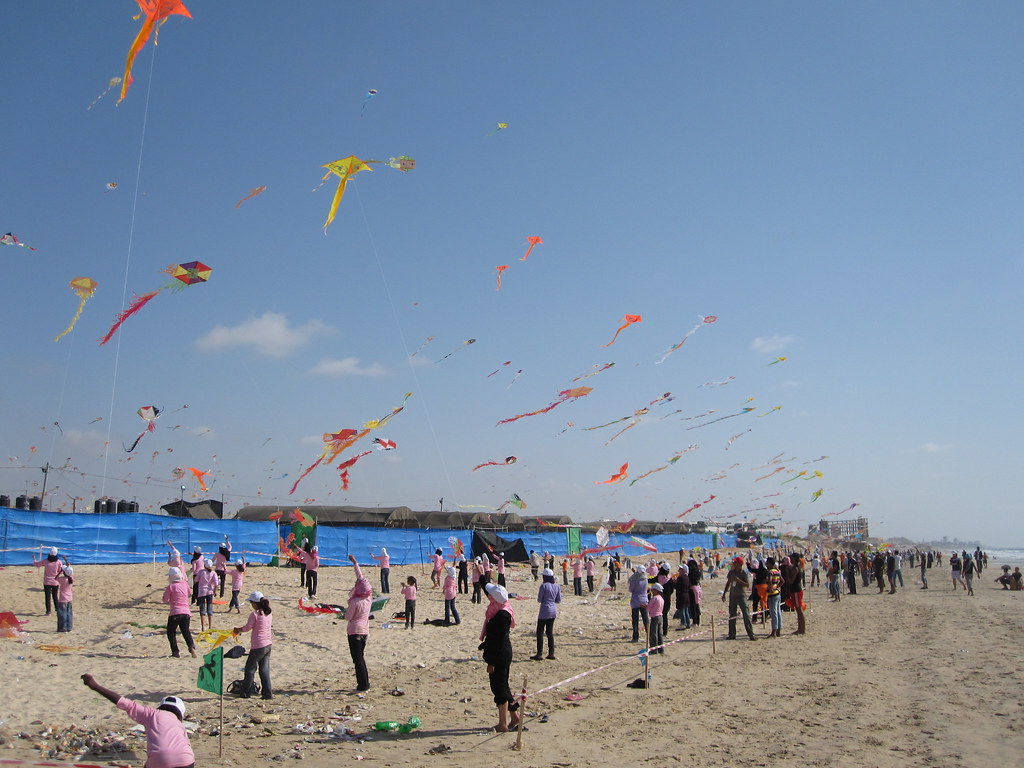
Impressions of Gaza run together, mingling good times with sad, clear acts of bravery and heroism along with cowardice and criminality. Overall, when I think of Gaza visually, I see sand, sand everywhere and poverty next to the most beautiful stretches of the Mediterranean imaginable. Children, searching for childhood every time there was a lull in the fighting, would be flying home-made kites of all sizes, wading barefoot in the gigantic puddles that would overflow the potholes in the streets making the roads impassable for days and sometimes for longer if the rains continued. Yet they played, trying to steal a moment for normal childhood out of an otherwise extremely difficult situation. In one spot near the sea, children had found an abandoned shell of a car and for months it was one of their favourite playthings. It became a jungle gym, a hideout, a fort and assumed all sorts of play functions. We would have been concerned that parts of it were sharp and parts of it had been burned so it was dirty and rusty but for the children, it was something wonderful and allowed their fantasies full range to be played out. Whenever I walked by this scene I saw children playing in and around it. That old hulk of a car was the closest thing the children had to a playground in those times.
Food, water and religion
Sights, sounds and smells fill my thoughts as I remember living in Palestine. One of the smells that is most memorable to me is of superb cooking! The hospitality and graciousness of the Palestinians are famous and their reputation is well deserved. Innumerable times my husband and I were treated to the most delicious meals imaginable. A few years later when my husband and I were living in the former Soviet Union and there was very little food and no way to cook it, we used to lie in bed, since it was the warmest place, and imagine that we would be going to dinner at friends’ homes in Gaza. We would even try to imagine what delicious treats were in store for us that evening.
As I think back now, I am almost sure that families sacrificed to feed us such wonderful meals but at the time we basked in their hospitality without the full realization of the family foods we were consuming. That kind of kindness was ubiquitous. People literally risked their lives during “lockdown curfews” to make sure we had enough food and especially if they had something fresh or considered a delicacy. Once, during a major lockdown, neighbours risked their lives by going out of their homes when Israeli soldiers were in the neighbourhood to bring us special sweets someone had brought from the West Bank. That was the kind of warmth we consistently experienced while living in Palestine and experienced later when we returned to visit.
Water was a real problem in both the West Bank and Gaza. It does not help a population like the Palestinians, when another population like the Israelis, wants all of the water, no matter where it is. In the West Bank at the time of the first intifada, the Israelis were drilling wells deeper than the Palestinian wells and thus drying out Palestinian agricultural land.
At the time we were living in Gaza we were told that all the sweet water went to the then-expanding settlements and to the Negev and Beersheba areas for the exclusive use of Israelis. We also were informed by international organizations that so much water was being diverted from the underground aquifers leading to Gaza that those ancient aquifers were filling up with seawater. The rate of kidney disease in Gaza was already very high because of such salinity.
Just to show you how bad the water was, when a pot of tap water boiled over, the pot was white around the places where the water had spilled. The tap water was that brackish. People used lots of sugar in their tea partly to kill the salty taste. Also, they would make a tea from sage which was delicious and camouflaged the salty residue.
Religion was ever-present and very important in Palestine. People would talk about what The Quran would say about almost anything and Islamic and Christian principles prevailed, especially as they concerned helping one another. It was practically mandatory to visit the sick and those in mourning. It was incumbent to help those in need, whatever the need and with whatever resources one had, however meager. I was presented in Gaza with an Islam that was kindly, caring and responsive to ordinary as well as extraordinary needs within the community, an Islam that stated the major jihad was fighting one’s own internal demons above all else.
The other jihad was to fight for the rights guaranteed under Islam and Christianity and by such august bodies as the U.N. and as codified in the various conventions such as the U.N. Convention on Human Rights and the U.N. Convention on the Rights of the Child as well as, of course, the Geneva Convention. There are many other codifications of human rights of which the Palestinians are acutely aware and which they do not have as a direct result of the occupation. One man on a more recent trip to Palestine told me, “All we have now is Allah. No one else seems to care about our plight!”
And always there was the fighting, one side giving high-pitched whistles to know when and where to assemble to throw rocks, the other side responding with bullets and blasts. It sounded like being in an arcade except that sometimes the sounds would last, sometimes they were closer and sometimes further away. There were times we would be sitting with friends drinking tea and then the shooting would start. We would try to guess which area was “blowing up” and would hope that no one we knew would get killed. Often, if things were “bad,” meaning there were a lot of dead and injured, my husband would receive a call and would have to dash off while I continued to drink tea and feel the unreality of the situation. I mean, how could I just sit there when people were getting killed? But what else could I do?

Angry soldiers
Stories abound about that time in Gaza. The toddler playing in the street in front of her home under the watchful eye of her mother and yet still run over by an Israeli jeep, crushing both of her little legs, the infant in his mother’s arms on the balcony whose eye was shot out simply because the soldiers couldn’t find her teenage brother at home are just two that have stayed with me. I can’t help but wonder what has happened to those and so many other children whose lives were irrevocably changed in a moment in time that should have gone another way.
Once when there was a major curfew and the streets were deserted, Israeli soldiers beat a donkey tethered outside its owner’s home so badly that it had to be put down. People said that because of the curfew the soldiers were angry they couldn’t find anyone to beat up so they had to attack something. That something was an innocent donkey.
But killing was everywhere and all the time. People of all ages were killed and injured, many, many of them innocent children. Funerals happened continually and seemed to be a good time for the Israeli soldiers to kill young mourners, actually to kill anyone. Though forbidden by the Israeli authorities to assemble, social and religious dictates required family members and the community to attend a wake house to grieve with the family. Jeeps would circle the house where mourners were gathering and would open fire whenever they wanted. It was expected. The vast, vast majority of time there was no provocation from the mourners: they were simply and truly mourning.
There is so much more to say about life in Gaza but I shall end my reminiscences with a poem,
Future for Palestine
Do they expect us to blow away
like grains of desert sands
scattering unseen and without sound
into seas and rivers
or do they want us to be discarded
like bent bottle caps
leaving only rusty circles on
well-traveled highways?
Tell us, tell us, oh world,
your plans
so our dreams can be packaged
like bags of bruised fruit
and given to our children.
Mandy Fessenden Brauer, M.S.W., Ph.D., is a North American writer, currently residing in Bali, Indonesia.
 Inclusive Journalism
You must be logged in to post a comment.