
Sometimes it’s good to understand something by knowing what it is not. The interview TalkTV’s Julia Hartley-Brewer did with Palestinian Dr. Mustafa Barghouti is an example of what Complicating the Narrative… is not. The method was introduced by journalist Amanda Ripley in the eponymously titled article in 2018 and contains four steps. The steps aren’t sequential, they’re different elements to add to a story.
- Listen differently
- Go beneath the problem (ask questions about people’s motivations)
- Embrace complexity (widen the lens geographically or historically)
- Counter confirmation bias (amplify contradictions)
It’s not:
- Us vs them
An important question to ask beforehand is “What is the narrative we’re trying to complicate?”. To know the answer you need to know what your audience is feeling, processing and what stories they’re consuming. It is essential to know your audience. Now, let’s have a look at how this plays out in the interview mentioned earlier.
The platform, the audience and the presenter.
TalkTV is a British free-to-air opinion-orientated television and radio channel owned and operated by News UK Broadcasting founded by Rupert Murdoch. Head of TV is Richard Wallace who worked for Daily Mirror before. Among the presenters are hired-to-be-controversial Piers Morgan, Brexit supporter and self-acclaimed republican Julia Hartley-Brewer and former MPs from the Boris Johnson administration like Nadine Dorries. The latter caused a stir for having breached the Government’s anti-corruption rules. Former presenter Tom Newton Don described TalkTV at the start as “not a right-wing network”. In an interview with Press Gazette he states:
“The key is getting on with each other” rather than having them devolve into shouting matches. Fundamentally disagreeing on a whole load of things but in a respectful, engaging way. Shouting and screaming at each other, that’s not what we’re going for.”
Despite Newton Don’s good intentions, the channel receives regular criticism on social media for doing the opposite and Newton Don himself already left the organization.
The Interview
“Fearless and feisty, JHB tackles the biggest issues every day with the biggest guests” reads TalkTV’s description on the website. In this episode, Julia Hartley-Brewer tackles the news about the killing of senior Hamas leader Saleh al-Arouri by – what everyone assumes – the Israeli army and invited physician, activist, and General Secretary of the Palestinian National Initiative (PNI) Mustafa Barghouti to comment on the situation.
She introduces her guest with the following words:
“I would say it’s a jolly good thing that this man is no longer alive. I say well done to Israel, or whoever else is going to claim that they carried out this air strike.”
She soon after asks Barghouti the first question, a closed question on which he can either answer ‘yes’ or ‘no’:
“It’s a good thing when terrorist leaders are assassinated isn’t it?”
Let’s already pause here for a second. Besides the fact that a closed question pushes an interviewee to a simple answer, it is also remarkable for a journalist to cheer on someone’s death, whoever that person is. Hartley-Brewer reveals her confirmation bias* already in the introduction of the conversation.
What happens next is the core of what goes wrong in the interview. Barghouti responds with a clear ‘no’ but also expresses his indignation about her harsh language:
“No, it’s not good because they are not terrorist leaders and I am so surprised that you are encouraging the assassination of political people. And uh…”
She interrupts, they cross-talk :
“I’m encouraging the assassination of people who…”
He continues:
“…encouraging, encouraging… wait a minute, let me answer, please.
(…)
You are encouraging the violation of international law. Not only Israel is assassinating a Palestinian leader, and provoking a reaction for sure. But more than that, they’re doing that on the land of another country, in Lebanon. Insulting the Lebanese government, and the Lebanese security structure and insulting the Lebanese people. If every country… “
She interrupts him:
“So I want to clarify… You think it’s terrible that everyone assumes it’s Israel, that Israel went into another country and killed somebody and yes that would provoke a reaction.“
Let’s pause again. The interviewee doesn’t get much time to clarify his point of view. Before he ends his sentences, she already interrupts him. Her hastiness puts continuous pressure on the conversation and she expresses it in her body language too by slamming her desk multiple times, waving with her arms and using negative facial expressions, such as frowns or raised eyebrows.
An interesting point in regards to Complicating the Narrative is her summary of what he is saying. She wants to ‘clarify’ but doesn’t give him a chance to confirm if she got it right. Instead, she talks right over it and poses the next closed question, maybe the most controversial and repeated one in the context of this issue:
“Um, did you make the same comments about the October 7th massacre?”
What happens next is that Barghouti bounces the ball back and asks her to condemn the actions of the Israeli army in Gaza. It turns into a classic example of the polarization happening around this topic. Barghouti tries to contextualize by mentioning the history of the conflict, but Hartley-Brewer continues to insist on keeping it simple. Yes or no. Us versus them.
At the end of the conversation, the interviewer completely loses herself and shouts at the interviewee with another expression of her confirmation bias leading to a racist comment:
“Oh my God, for the love of God let me finish a sentence man! I don’t know maybe you’re not used to women talking.”
How to complicate this narrative?
The example chosen here is quite extreme and there are multiple easy ways to have done a better job than Julia Hartley-Brewer on TalkTV did. Asking more open questions, expressing less biased opinions, and showing more respect to the guest. In the context of Complicating the Narrative, this conversation would benefit immensely from applying the four steps:
1. Listen differently.
First of all a practical issue: there is a delay on the line and that should have been addressed right away by the presenter. The guest is always at a disadvantage when this happens because he can only hear her through his comm unit.
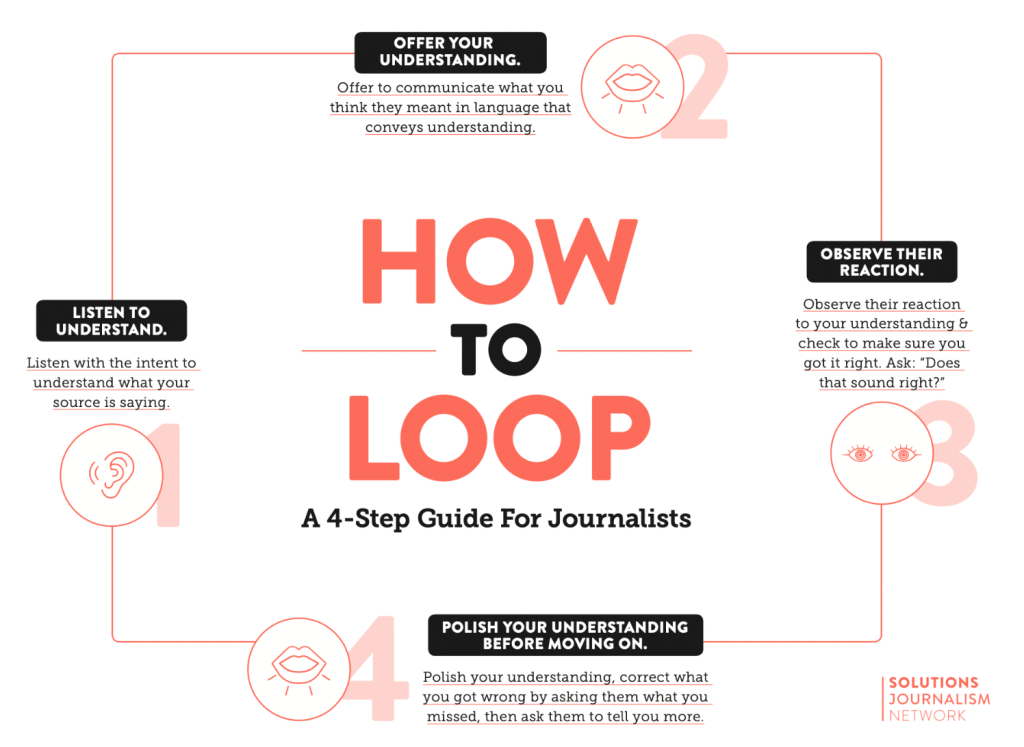
Secondly, she interrupts him regularly and when summarizing his answers, she doesn’t check if she understood him right. The exercise of looping helps to listen better and reach an understanding.
2. Go beneath the problem
Regarding the content, he gives openings for questions that go beneath the problem. For example, by saying that the killed Hamas leader is not a terrorist. She could have asked:
“Is there any part of the reasoning behind viewing Hamas as a terrorist organization that makes sense to you?”
Other possible questions could have been:
“Why is it important to you that I condemn Israel’s actions in Gaza?”
“What is dividing us on this issue?”
“Can I interrupt you, I want to make sure I have everything right?”
“What is the question no one is asking regarding this assassination?”
“How has this conflict affected your life?”
The 22 questions to complicate the narrative are available here, but for each issue, you can create new questions yourself.
3. Embrace complexity
Dr. Barghouti tries to broaden the lens of the topic by not only addressing the history of the conflict but also pointing out Netanyahu’s controversial career and the fact that the Israeli leader is losing the support of his people.
Another way to embrace complexity is by widening the lens geographically. What is the meaning of this conflict in a geopolitical sense? What effect will the assassination of the Hamas leader have on global politics? How will Lebanon respond and what about other countries in the region?
4. Counter confirmation bias
Hartley-Brewer cheers on Israel’s war actions before the interview starts and hints at her confirmation bias that Palestinian men don’t want to speak to women at its very end. The interview is completely biased and that’s a shame. Even though TalkTV is known as a right-wing leaning channel, presenters should still work towards objectivity as part of their profession.
Another way to go about this is to clearly express the point of view and use it in the conversation. For example:
“I have been taught that Israel is defending itself. Why does that view not resonate with you?”
“Help me make sense of this because a lot of people are saying that Palestinians are all supporting Hamas?”
“What do you think this Israeli government wants?”
Conclusion
The Israel-Hamas war is probably the most polarizing topic of this moment and it is not easy to complicate the narrative when the war is still going on in full effect. It is clear though that interviews like the one discussed here will polarize the issue even further, making people lose trust in journalism and completely turn away from people who think differently.
Subscribe to the Inclusive Journalism Weekly for more on Complicating the Narrative.
 Inclusive Journalism
You must be logged in to post a comment.